


A human-controlled AI robotics authoring system that plans, builds, validates, exports, simulates, and improves task-specific robots through explicit approval gates.
Purpose
SimForge Evolve was built for OpenAI Build Week to explore the shortest safe path from a human need to a machine suited for the task. A text prompt starts an autonomous engineering loop, but the human stays in control through explicit approvals, bounded changes, and deterministic checkpoints.
What I built
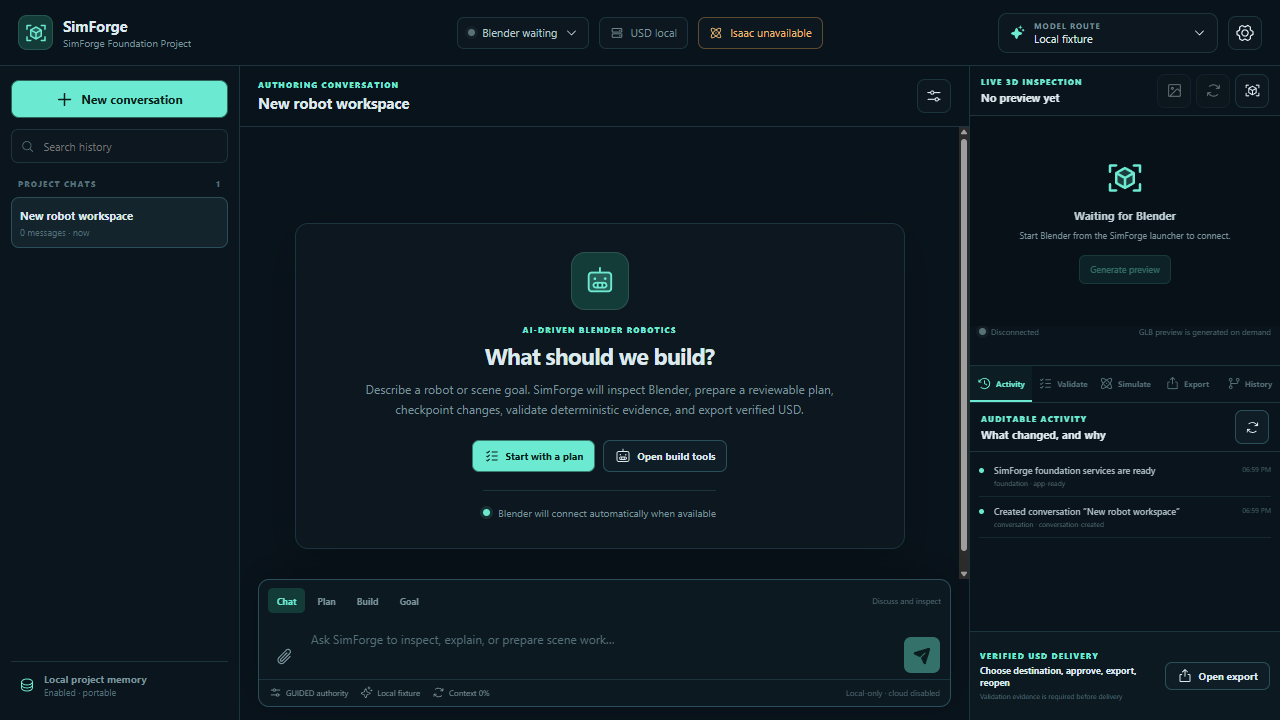
The Windows desktop application guides a robot through inspect, plan, build, validate, export, reopen, and simulate stages. In the demonstration, SimForge plans a wheeled robot with a gripper, waits for approval, creates the robot and workcell in Blender, validates the scene, exports modular OpenUSD, reopens the package for verification, and sends it to NVIDIA Isaac Sim.
Blender is the visual source of truth. A sandboxed renderer and narrow IPC boundary keep the desktop interface separated from privileged operations, while an authenticated loopback bridge gives the application controlled access to Blender.
Simulation feedback
The first simulation exposes a stability problem and returns deterministic evidence. SimForge proposes a bounded correction, waits for approval, updates the design, re-exports it, and completes a passing waypoint rerun. The result is a traceable engineering loop where failure becomes structured input for the next design decision.
Verification
The project includes 57 passing default automated tests, 6 additional opt-in tests, 5 real Blender acceptance paths, and 12 OpenUSD reopen checks. The workflow is supported by 133 traceable requirements and 42 acceptance scenarios.
Stack and current state
SimForge Evolve combines Electron, TypeScript, React, SQLite, Blender 4.5 LTS, OpenUSD, Python, and optional NVIDIA Isaac Sim integration. The primary demonstration route uses NVIDIA and Nemotron, with an optional OpenAI Responses API provider. I built the first complete version with Codex and GPT-5.6 in three days, and the Windows v0.1.2 release is available from GitHub.